
50 HOURS ISN’T A STRATEGY
The Equalex framework was developed precisely because the challenge isn't simply accumulating work experience hours. It's about creating multiple, meaningful and progressive experiences, connected to learner outcomes and delivered over time rather than as a single intervention. The framework was designed to support a multi-year approach to workplace experiences in line with economic growth sectors, and aligns with the move towards two weeks of work experience by the end of Year 11.
Having worked with the Careers and Enterprise Company since the introduction of this concept, I helped explore what this could look like in practice, testing the strategic thinking, in addition to innovative programme design that connected curriculum, place, identity and opportunity.

THE CHALLENGE
How do you turn a national entitlement into meaningful, equitable encounters at scale?
The challenge surrounding the development and implementation of the new statutory guidance was to make sure that employer encounters and workplace experiences genuinely contributed to learner progression, curriculum outcomes and future opportunity, regardless of where a young person lived or which school they attended.
The emerging Equalex framework proposed a more intelligent model, connecting careers education, curriculum learning and employer engagement through meaningful experiences matched to learner development.
The question was whether this could work outside policy documents and guidance.
To inform future implementation, the Careers & Enterprise Company and delivery partners needed evidence from real schools, real employers and real learners. The system needed testing before it needed scaling.
MY ROLE
I was asked to help work out how the model could ‘ready the system’ from the outset of reform.
CO-DESIGN IT.
How could a major employer work across multiple regions to turn the emerging Equalex framework into meaningful experiences aligned to the curriculum, appropriate to learners' stage of progression in a way that was both sustainable in terms of participation, relevance to place, and outcomes driven.
TEST IT.
How could those experiences actually be delivered with pilot cohorts across different regional contexts and demographics of young people, whilst using real employer capability and live projects rather than designing something theoretically?
FEED THE LEARNING BACK.
What worked? What didn't? What did employers need? What did schools need? What changed across different learner cohorts and places? And what recommendations should be fed back through CEC and DfE as the model and subsequent statutory guidance developed?

MY APPROACH
PERSPECTIVE
I acknowledged that a new entitlement to meaningful workplace experience would only succeed if employers helped shape what ‘meaningful’' looked like in practice - and before it became a statutory expectation.


AGENCY
I created new partnership combinations that could turn workplace experience into something richer than a traditional employer-school model, using the ecosystem of place to create innovative employer pathways.

STEWARDSHIP
I created the conditions to learn before scaling, designing and testing innovative approaches that generated practical evidence for how the Equalex reforms could work both nationally and regionally.
GREATER MANCHESTER COMBINED AUTHORITY: MAKING NUMBERS MEAN SOMETHING
I knew that 10 million people in the UK were financially illiterate. Learning the basics, from percentages and ratios, to reading a bus timetable or measuring cooking proportions, and even choosing the best interest rate, really matters if people - whether they're 18 or 81 - are to feel included, empowered and in control.
But I could also see the connection to the economy young people were growing into.
Financial and professional services were an important part of Greater Manchester's growth economy, while numerical confidence underpins routes into occupations across sectors including commercial and project management, engineering, technology and the built environment. Budgeting, bidding and analysing data is incumbent to all roles.
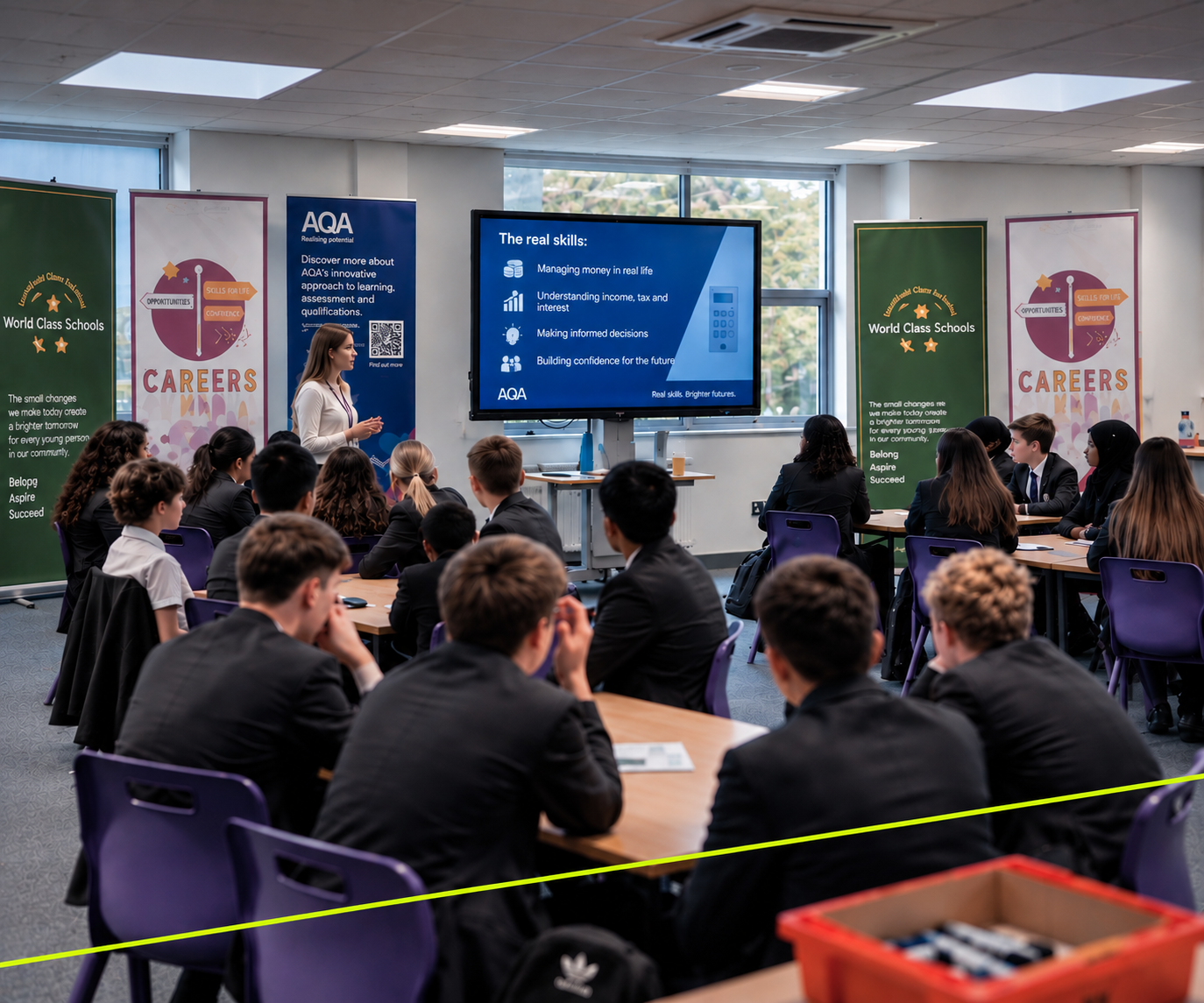
AQA is headquartered in Manchester and was developing a new numeracy prototype designed to sit alongside GCSE Maths. I was part of the expert steering group developing that work and saw an opportunity to connect it with the Greater Manchester Equalex trial.
We brought together AQA's curriculum and assessment expertise with real people, careers and occupations from AtkinsRéalis. Young people were given job profiles and salaries, then asked to navigate the financial decisions life might actually throw at them: budgeting, unexpected costs, saving, borrowing and understanding interest.
Alongside that came career exploration. Quantity Surveyors, Risk Experts, Robotics Technicians and Project Managers all use numbers differently every day. The point wasn't to persuade every young person to become an engineer. It was to help them see the connection between what they were learning, how numbers shape everyday life, and the occupations and opportunities that stronger numerical confidence could help open up.

LIVERPOOL CITY REGION COMBINED AUTHORITY: FROM PERSONAL BRAND TO THE BRAND OF PLACE
AtkinsRéalis was working on the business case for the £5bn redevelopment of Liverpool Central Station and the surrounding regeneration area. Rather than create a hypothetical employer exercise, I saw an opportunity to use a real project and visible city asset, that would shape how people moved around the city, access work, education and leisure.
The day began with personal brand: helping young people understand their strengths, what made them different, how others might perceive them, and how they could communicate what they brought to the table. I wanted them to build the confidence to recognise that their own perspective had value, because later in the day, we were going to ask them to use it.
From there, we travelled into Liverpool Central Station. With the station manager, the young people explored the station as passengers but were asked to start thinking like the people responsible for its future. How safe did it feel? Was the lighting right? Could they navigate it easily? What was the passenger experience like? Where were the opportunities for retail, regeneration or making the station more of a destination?
Back in the workplace, they were assigned roles including Project Director, Communications Director and Commercial Director and challenged to redesign Liverpool Central Station together, drawing on what they had observed and learnt.
The personal-brand work became a golden thread through the experience. They had to contribute their own perspective, work with people bringing different strengths, advocate for their ideas and ultimately present and sell their proposal — practising some of the same skills they would later need to articulate their value in an interview or workplace.

THE IMPACT
12 SECONDARY SCHOOLS AND 350 STUDENTS
Tested across diverse student cohorts involving different ages, abilities and aspirations

PARTNERSHIP FOR MUTUAL BENEFIT
An integrated, large scale North-West trial of AQAs working numeracy prototype and the new Equalex model

Jess played a pivotal role in shaping our numeracy product, bringing clarity, direction and purpose from the outset. She created a genuinely co-creative envioronment between AtkinsRealis and AQA , aligning expertise - from curriculum and assessment design thorough to industry insight.
Jess is an inspiring leader with a rare combination of strategic insight, collaboration and delivery focus.
NATALIE WILSON Product Manager, AQA Global Assessment Services